by Apostille Service
Share

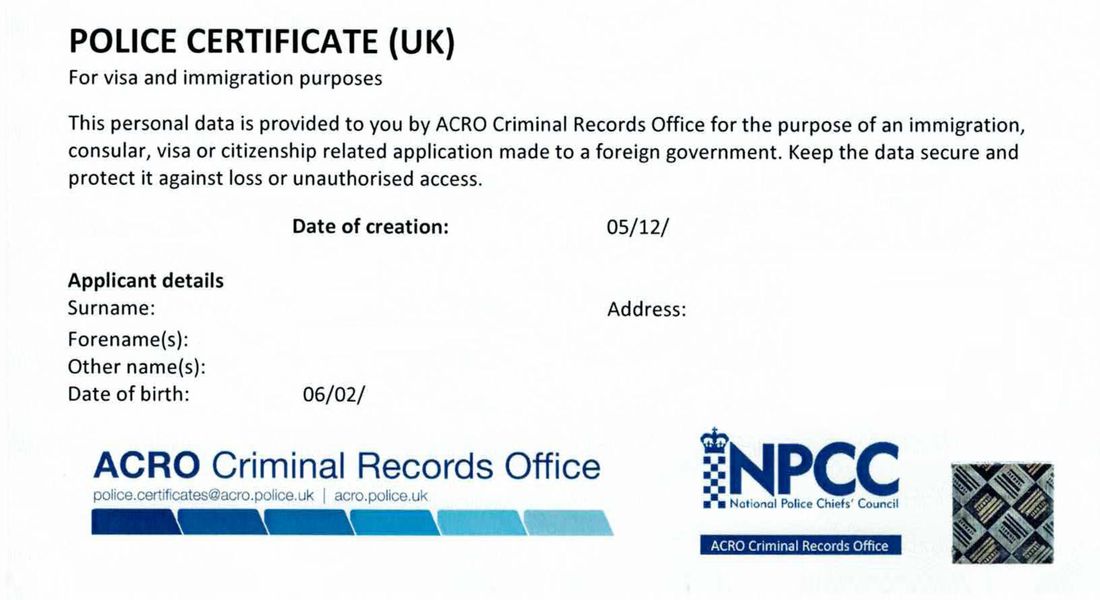
As more countries move towards digital solutions, the traditional paper apostille is slowly being replaced by the e-Apostille. If you have been told your document can receive an e-Apostille, you might be wondering what this actually looks like and how it differs from the familiar paper version.
This article explains what an e-Apostille looks like, how it is presented, and how it can be verified.
What is an e-Apostille?
An e-apostille is a digital version of the apostille certificate issued under the Hague Convention. Instead of being physically attached to your original document with glue and an embossing seal, the e-Apostille exists as an electronic certificate, provided within a secure PDF file.
It serves the same legal purpose as a paper based apostille. It confirms that the signature, seal or stamp on your document is genuine and has been issued by a recognised authority.
What is included on the e-Apostille in the UK?
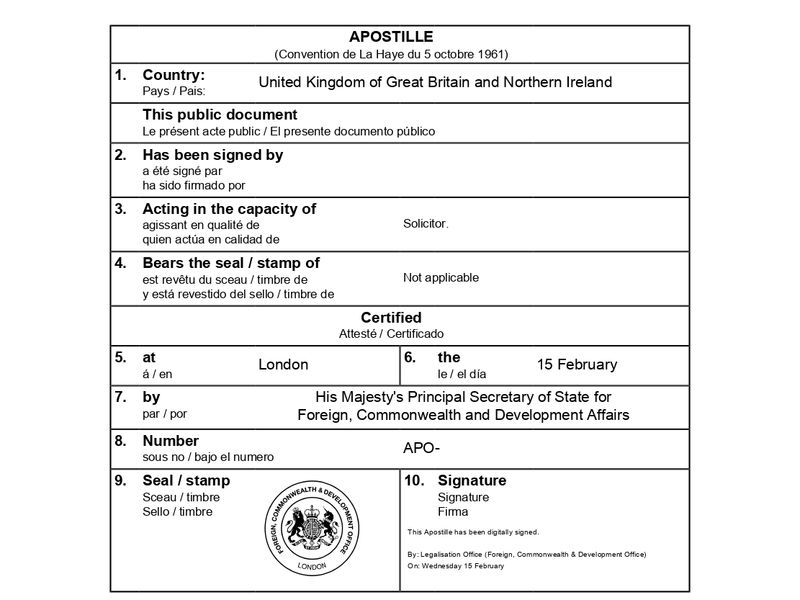
The e-Apostille and paper apostille follow a prescribed format, under the Hague Convention:
The apostille includes ten numbered standard fields. These fields contain essential information:
- Country of issue
- Name of the digital signatory on the document – (see notes below)
- Capacity in which the signatory has acted
- Details of any seal/stamp on the document- (see notes below)
- Place of issue
- Date of issue
- Issuing authority
- Apostille certification number
- Digital picture of the government stamp
- Digital signature statement from the FCDO Legalisation Office
Notes on points 2 and 4
For traditional paper apostilles, either box 2 or 4 is completed. Occasionally, both boxes are completed.
Example 1 – A court ink stamped divorce document – Box 4 is completed. Box 2 will say ‘not applicable’ as there is NO SIGNATURE.
Example 2 – A notarised power of attorney – Box 2 shows the notary name. Box 4 will state the notary seal.
For e-Apostilles, only box 2 is completed. There is no ‘physical seal or stamp on a digital document.
Merged PDF format
The e-Apostille is merged with your digital document into a single PDF file. The file normally includes
- Letter from the FCDO Legalisation Office with advice on the e-Apostille
- Your digital document
- The e-Apostille certificate
You can learn more about the PDF file on our how to view the e-Apostille article.
How you receive an e-apostille
Instead of posting physical documents back to you, we will send you:
- A downloadable PDF file via email
- Instructions on downloading Adobe PDF to view the file
This allows for immediate international sharing without postal delays or risk of loss.
How to verify an e-apostille
Verification is simple. Visit the FCDO gov.uk website verification page.
- Enter the reference number on the FCDO Legalisation Office website
This will display confirmation details showing the apostille is valid. It does not confirm the details of the document included in the PDF file.
What it looks like in practice
When you open the e-Apostille file, you will see:
- Your original document displayed clearly
- A formatted digital apostille certificate page
- A cover letter from the FCDO Legalisation Office
It is a secure file, that can be shared with third parties. It is not possible to print the documents. They remain as part of a complete file.
Is an e-Apostille legally valid?
Yes, provided it is issued by a recognised Hague Convention authority and accepted by the receiving country. Acceptance of e-Apostilles continues to expand as more governments and organisation recognise these. However, you will find that many organisations still request paper apostilles on physical documents. This is particularly true when you are submitting physical documents overseas.
If you are unsure whether the country you are submitting your document to accepts e-Apostilles, it is always best to confirm in advance.
Summary
An e-Apostille is an official digital certificate attached to your document, provided as a secure PDF file. It includes key identifying details, digital signatures, your document and the e-Apostille. While it lacks the physical ink signature and stamp of a traditional apostille, it carries the same legal weight when properly issued and accepted.
For individuals and businesses, the e-Apostille offers a faster, safer and more modern solution for international document legalisation.
Find out more about our services….
We provide fast document legalisation for UK documents. Providing electronic e-apostilles and paper based apostilles for UK documents. We legalise UK documents in just 2 days
- Excellent customer support
- Online order updates
- Over 2 decades of experience
The trusted apostille service for thousands of customers.

As more countries move towards digital solutions, the traditional paper apostille is slowly being replaced by the e-Apostille. If you have been told your document can receive an e-Apostille, you might be wondering what this actually looks like and how it differs from the familiar paper version.
This article explains what an e-Apostille looks like, how it is presented, and how it can be verified.
What is an e-Apostille?
An e-apostille is a digital version of the apostille certificate issued under the Hague Convention. Instead of being physically attached to your original document with glue and an embossing seal, the e-Apostille exists as an electronic certificate, provided within a secure PDF file.
It serves the same legal purpose as a paper based apostille. It confirms that the signature, seal or stamp on your document is genuine and has been issued by a recognised authority.
What is included on the e-Apostille in the UK?
The e-Apostille and paper apostille follow a prescribed format, under the Hague Convention:
The apostille includes ten numbered standard fields. These fields contain essential information:
- Country of issue
- Name of the digital signatory on the document – (see notes below)
- Capacity in which the signatory has acted
- Details of any seal/stamp on the document- (see notes below)
- Place of issue
- Date of issue
- Issuing authority
- Apostille certification number
- Digital picture of the government stamp
- Digital signature statement from the FCDO Legalisation Office
Notes on points 2 and 4
For traditional paper apostilles, either box 2 or 4 is completed. Occasionally, both boxes are completed.
Example 1 – A court ink stamped divorce document – Box 4 is completed. Box 2 will say ‘not applicable’ as there is NO SIGNATURE.
Example 2 – A notarised power of attorney – Box 2 shows the notary name. Box 4 will state the notary seal.
For e-Apostilles, only box 2 is completed. There is no ‘physical seal or stamp on a digital document.
Merged PDF format
The e-Apostille is merged with your digital document into a single PDF file. The file normally includes
- Letter from the FCDO Legalisation Office with advice on the e-Apostille
- Your digital document
- The e-Apostille certificate
You can learn more about the PDF file on our how to view the e-Apostille article.
How you receive an e-apostille
Instead of posting physical documents back to you, we will send you:
- A downloadable PDF file via email
- Instructions on downloading Adobe PDF to view the file
This allows for immediate international sharing without postal delays or risk of loss.
How to verify an e-apostille
Verification is simple. Visit the FCDO gov.uk website verification page.
- Enter the reference number on the FCDO Legalisation Office website
This will display confirmation details showing the apostille is valid. It does not confirm the details of the document included in the PDF file.
What it looks like in practice
When you open the e-Apostille file, you will see:
- Your original document displayed clearly
- A formatted digital apostille certificate page
- A cover letter from the FCDO Legalisation Office
It is a secure file, that can be shared with third parties. It is not possible to print the documents. They remain as part of a complete file.
Is an e-Apostille legally valid?
Yes, provided it is issued by a recognised Hague Convention authority and accepted by the receiving country. Acceptance of e-Apostilles continues to expand as more governments and organisation recognise these. However, you will find that many organisations still request paper apostilles on physical documents. This is particularly true when you are submitting physical documents overseas.
If you are unsure whether the country you are submitting your document to accepts e-Apostilles, it is always best to confirm in advance.
Summary
An e-Apostille is an official digital certificate attached to your document, provided as a secure PDF file. It includes key identifying details, digital signatures, your document and the e-Apostille. While it lacks the physical ink signature and stamp of a traditional apostille, it carries the same legal weight when properly issued and accepted.
For individuals and businesses, the e-Apostille offers a faster, safer and more modern solution for international document legalisation.
Find out more about our services….
We provide fast document legalisation for UK documents. Providing electronic e-apostilles and paper based apostilles for UK documents. We legalise UK documents in just 2 days
- Excellent customer support
- Online order updates
- Over 2 decades of experience
The trusted apostille service for thousands of customers.